This post is going to outline the ending of this book in detail, so if that's not your thing then don't read on, I guess. Consider yourself spoiler-warned or whatever. I also listened to it as an audiobook, so I don't have anything interesting to say about the layout of the writing
besides that
I'm glad I didn't
have to
slog through
a whole book
of this.

This is one of those books that sits on my ebooks holds shelf until I forgot why I put it on hold in the first place, then my turn to have it comes, I download it to my phone, and since it is shorter than all the other audiobook options I currently have checked out, I listen to it. The narrator was good, so I pressed on. I like audiobooks, they make my life easier.
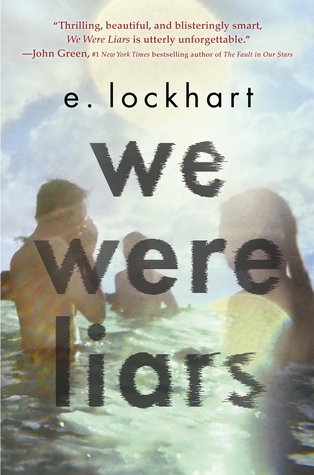
So: the book. Cadence (Cady) Sinclair suffers migraines but she does not suffer fools, or so she says. We Were Liars follows her, her cousins, and her love interest Gat (not her cousin, this ain't no Victorian lit) through a series of summers spent on her family's private island near Martha's Vineyard. In a word, the Sinclairs are privileged. It took me a while to decide whether or not I really cared about Cady and her family and her problems, and by the time I arrived at "meh" it was too late to turn back. Basically, Cady has head trauma of mysterious origin (because of AMNESIA) and we spend the book trying to figure out what it is. Blah blah blah there are a lot of over-drawn metaphors and some good bits and it's confusing when she describes emotions as physical trauma but also describes physical trauma as physical trauma with nary a distinction between the two. Are there real wounds involved? Your guess is as good as mine.
Here's where we talk about the ending.
Okay, if Lockheart had gotten to the burning the house down bit and stopped there, I would have been on board. Yes, they burned the house down, maybe someone got hurt, they killed the dogs accidentally, thank goodness Cady has remembered. BUT THEN Gat, Mirren, and Johnny were, wait for it, GHOSTS THE WHOLE TIME.

Once upon a time I arrived at my friends' house and they, for some reason unknown to the three of us, were watching some Nicholas Sparks twaddle; I don't even remember the title, nor will I put the effort into finding it. I asked what movie, they told me, I immediately started laughing, because I had heard (on a podcast maybe?) that this particular film ended with the big reveal of: she was a ghost the whole time. Nothing seemed more ridiculous to me in that moment than a story hinging on any number of characters being ghosts (The Sixth Sense, whatever, I haven't actually seen it) that only a person such as Nicholas Sparks, or I suppose M. Night Shyamalan, would come up with it. We fast-forwarded to the big ghost reveal and then fell on the floor in bouts of laughter.
Listen, I like unreliable narrators. I like clever twists. I like a good metaphor and a good reveal. I like this book fine except for the ending. What I do not like is a set of ghosts of people who are only dead because of truly remarkable ineptitude when it comes to arson. A word of advice, from someone who hasn't even burned a house down but does possess a modicum of sense: if you are on the main floor of a gas-soaked building and your cousins and boyfriend are on the other floors, wait until they (and you) are OUT OF THE HOUSE BEFORE YOU LIGHT IT. There is gas everywhere, it is a old building, it is full of paper and wood, it will burn NO PROBLEM. You don't have to monitor it! OH MY WORD.
E. Lockheart, I believe you can be better than Nicholas Sparks. Be better than Nicholas Sparks! Please, do it for the children.

