Showing posts with label Now a Major Motion Picture. Show all posts

3.04.2015

Silver Linings Playbook / Matthew Quick


   There aren't many things in the book-reading world that annoy me more than movie tie-in editions where the cover of the book is the same as the promotional material for the movie. Why must this happen? 

   Silver Linings Playbook the movie is enjoyable and features good performances from all, however I don't think it deserved as many Oscar nominations as it got but the Academy Awards are pretty stupid so no surprise there (Argo won best picture that year, and while it is amazingly dismissive of Canadians it's still a good flick). Silver Linings Playbook the book is not as good as the movie, which may seem like a thing a crazy person would say, but I stand by it. The book is fairly boring and formulaic, and really? Just don't bother. It's forgettable. It's possible that I would like this book more if I knew anything about football or cared about football, but I don't.

   If you want a more in depth review than "meh, don't bother", definitely take yourself over to the Book Fight podcast (which I very much enjoy but might offend some with its salty language) and listen to the episode where they talk about it: here is the link. Notably, they discuss the representation of race, mental illness, and therapy in the book, and compare the tome to airport hot dogs.

   My "Movies That Are Better Than The Book" list is now two entries long:
  1. Princess Diaries
  2. Silver Linings Playbook
   Why did I read Princess Diaries? Honestly, I have no idea. It was a weird time.

10.08.2014

I Capture the Castle / Dodie Smith


   As it turns out, a person doesn't necessarily have to be rich to live in a castle, as we quickly learn from Cassandra Mortmain as she narrates her life. No sir, you need not be rich, and by all accounts you can live in abject poverty and still live in a castle, so long as you have a long-suffering and understanding landlord.

   So! Cassandra et al live in a castle - what is left of a castle - on the grounds of a grand old house, and who should come round the cucumber frame but Mr MacGregor and by that I mean: single American hunks move in next door. Rose, Cassandra's older sister, decides that poverty really isn't all it's cracked up to be and sets about catching herself a rich American. She isn't very good at it at first on account of reading too many Victorian romances, and there are some misunderstandings, hiccups, etc on the road to love and let's just say that I'm really not doing the book justice so far and it is quite delightful.

   Back to the story: Simon (older American bro) has an awful beard but he also has an inheritance and owns the grand house and the grounds and the castle, so Rose sets her cap at him. He also has a penchant for literature, which proves to be a bonus since Cassandra and Rose's father once wrote an avant-garde novel that Americans simply eat up and Simon practically worships the ground he walks on. Neil (younger American bro) loves ranches and being, in general, American. Cassandra is all about the love of words and books and writing, and records the shenanigans that take place surrounding Rose's quest for love and money.

   Cassandra, it turns out, is charming and charismatic, although sometimes she is very earnest about various things, but aren't we all sometimes? If you can't be earnest every once in awhile then what are you doing. All this jibber jabber aside, let's get to my favorite character: Topaz.

   Topaz! She is the best. She loves art and she loves keeping her family as warm and fed and comfortable as she can and she also "communes with nature" which means she's an occasional nudist. She poses for paintings! She makes Rose and Cassandra clothing! She encourages Mortmain (the father, her husband) as best she can! The best lines come out of her mouth! There's no way Topaz is her real name but she owns it and she's great.

   A more complete cast of characters:
  • Cassandra, our narrator
  • Rose, our marriage-plotter. I feel like I haven't done Rose justice here. She's brave and she sticks to her guns.
  • Thomas, Cassandra and Rose's younger brother. He's very bright.
  • Mortmain, their father
  • Topaz, their step-mother (not evil, as Cassandra points out)
  • Steven, the farm boy
  • Simon, American bro
  • Neil, American bro
  • Mrs. Cotton, their mother. I didn't like her. 
  • The Fox-Cottons, awful people in some ways, not awful in others. 
  • The librarian whose name I forget but who is a lovely woman.
  • The Vicar, who is also great.
   As stated above, it's a delightful number and I encourage y'all to read it and enjoy it. It gets several stars out of however many.

7.31.2014

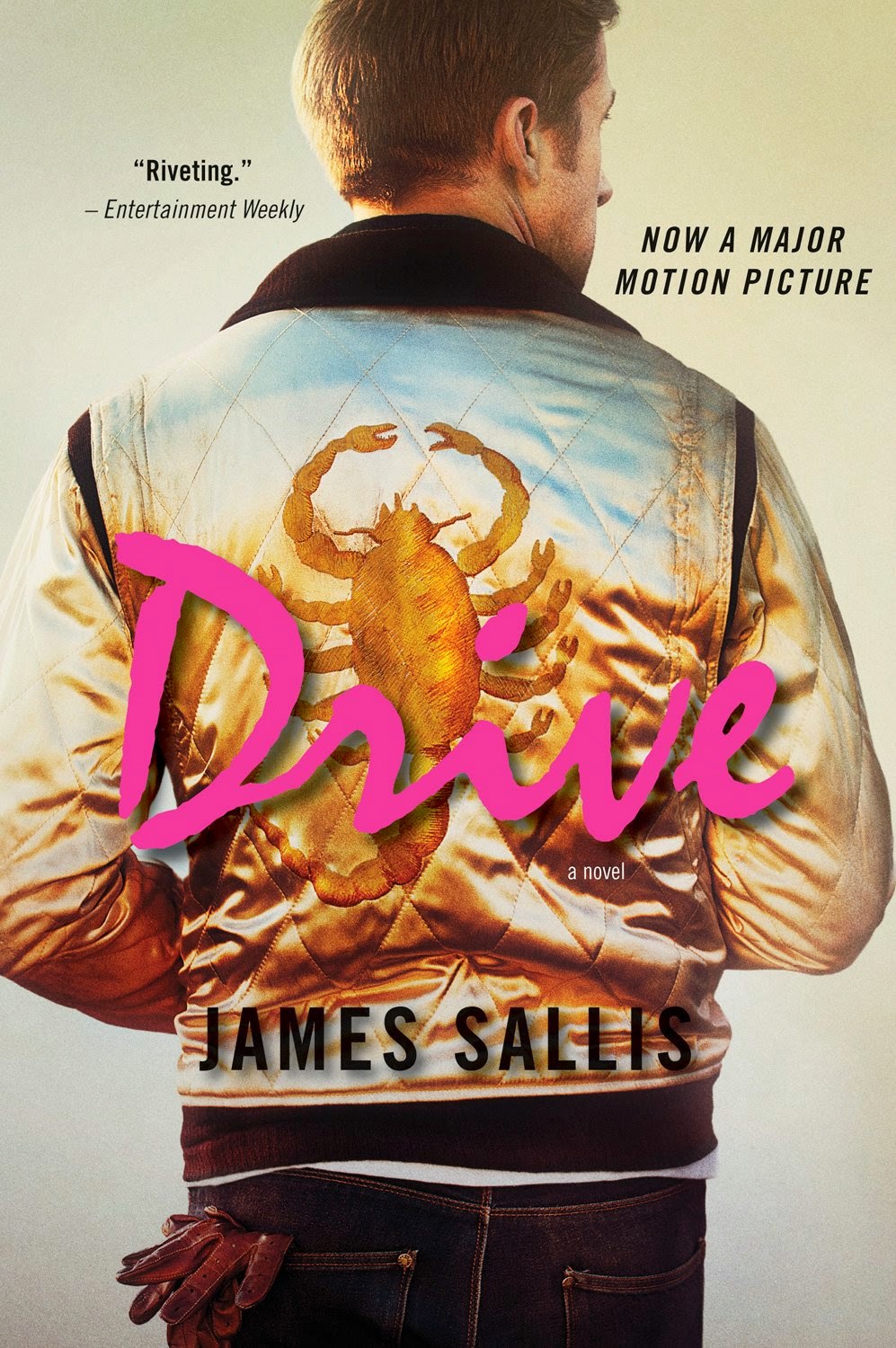
Drive / James Sallis


   I thought I had two books to review, but it turns out: I DON'T. I've just got one, and part of me doesn't feel like posting about it because there are few movie-versions-of-books that are quite so polarizing as Drive. People either hate Drive or they love Drive and I must admit: I'm in the latter camp. I watched Drive by myself in a movie theater in Auckland and when it ended I said "WOW". However, I went into it expecting very long shots and little dialogue so maybe I was prepared. I also watch many old movies, and have a deep and abiding love for film noir, so maybe all these contributing factors are the reason I love Drive and others don't. It's a mystery. I didn't actually know that Drive was based on a book, until I was at Chapters with a pal of mine and she said, "hey, look at this" and it was Drive by James Sallis and even though she isn't exactly fond of Drive-the-movie, she still found Drive-the-book for me. Thanks, man.

   This book opens with the scene in the hotel after the job goes wrong (you know which one?) which is a bit odd, since this event occurs at the middle of the story. When I moved along to the second chapter I said "what the what" before realizing that J Sallis used a device we in the biz like to call non-sequential storytelling. I am casting about for other books that use this device, and the only one I can think of at the moment is Slaughterhouse-5. The story doesn't follow a chronological sequence of events, but jumps around, and no: Drive does not include time-travel or alien abductions. It includes a lot of driving and a bunch of murderin'.

   I enjoyed this very short book (very short AND very large print, wowza. It barely takes up 180 pages) but I have some reservations in laying out an internet-wide recommendation. There are three dead bodies and a spreading pool of blood in chapter one, and it escalates from there. Plus a great deal of crime and etc. To be honest, I usually have reservations about giving a sweeping recommendation to anything. Qualms about everything, all the time. The communities I am a part of are very varied, and people's tastes/tolerances are as well, and I don't know what effect any given book will have on the people around me. If you had read everything I've ever read, in the same order and at the same point in your life, then I could be confident in foisting certain books on you. As it is, I can only say "I found value in this book for a variety of reasons and feel that others would appreciate it as well in favorable circumstances."

6.30.2014

Never Let Me Go / Kazuo Ishiguro


   While I haven't yet seen the new Spiderman movies, I can attest to Andrew Garfield's acting skills due to the viewing of Never Let Me Go and Boy A. Both those movies are worth your time, and both are adaptions from books. When I saw that Never Let Me Go / Kazuo Ishiguro was on the 1001 Book You Must Read Before You Die list, it put me over the edge and I finally got around to reading it.

   Cue tears of remorse over never reading anything by Ishiguro before.

   So: Kathy is writing a memoir of sorts, recounting her time at school with Ruth and Tommy, and what happened to them after they left Hailsham. Kathy is in her late 20's and works as a Carer, and is anticipating becoming a Donor and eventually completing. We learn quickly that Tommy and Ruth have both completed by the time Kathy is writing, and as a result she is largely friendless and alone. The book is slow, somber, and has an underlying foreboding.

   I spent the first half of the book trying to decide just how unreliable of a narrator Kathy is, and I never really arrived at a conclusion. And isn't that how first-person perspective books should be? Fun fact: a person is never 100% unbiased. It's a revelation, I know. I kept wondering if things were as significant for the other characters as they were for Kathy, or if Ruth really meant that in that way, or if Kathy thought something was clearly communicated when it wasn't. All this questioning of Kathy reminded me of situations in my own life where events have been interpreted and remembered very differently by different people, and can I just say: kudos to you, Kazuo Ishiguro.

   Time to get a copy of The Remains of the Day. Maybe I should start going through the Man Booker winners.